Trench Coat Buying Criteria: Fit, Fabric and the Rain-Breathability Trade
Sep 25, 2026 · Dana Reyes
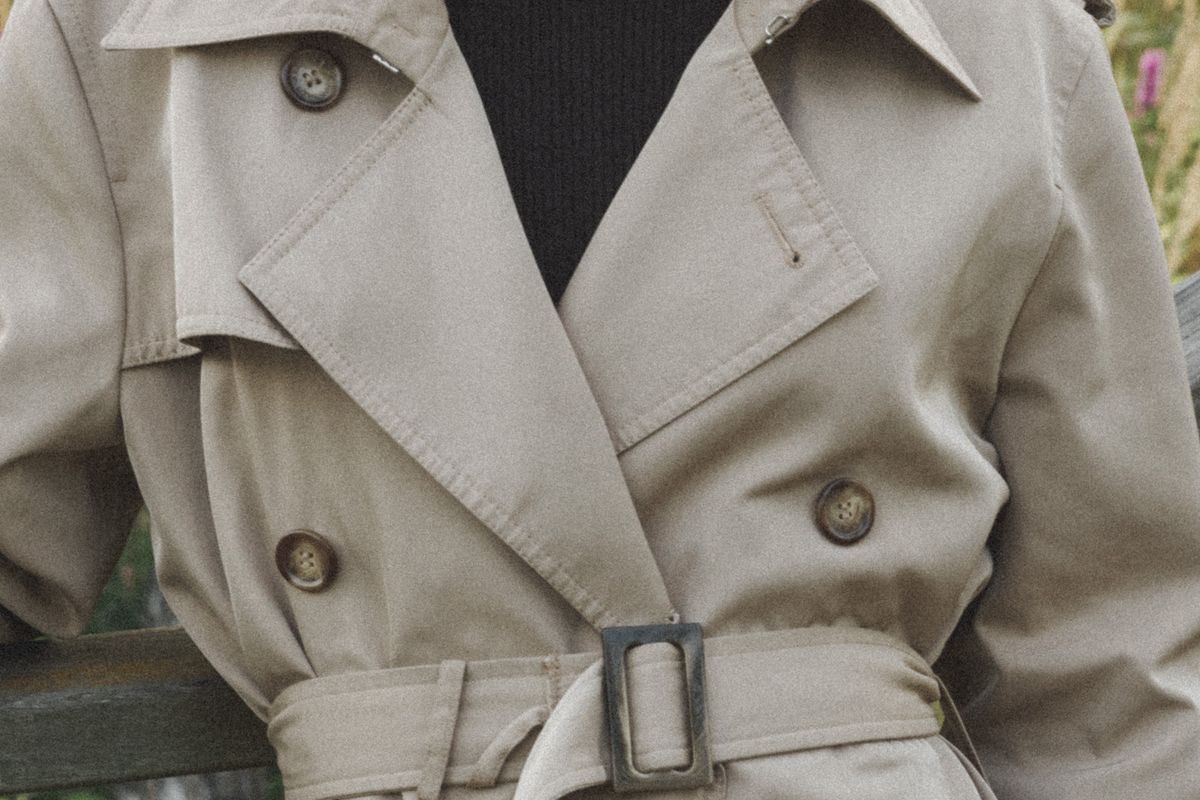
A trench coat is one of the few outerwear shapes that has barely changed in a century, which makes it unusually easy to judge: you are comparing how faithfully and how well a coat executes a known pattern. This guide sets out the criteria — shoulder, length, cloth, lining, hardware, and the rain-versus-breathability trade — and closes with why older coats are useful as a benchmark even if you never intend to buy one.
Fit: the shoulder line decides everything
Start at the shoulder, because a trench is a structured coat and the shoulder is what carries it. The seam should sit at the edge of your shoulder bone with enough room in the sleeve head that a blazer or a mid-weight knit goes underneath without the coat pulling across the back. If you plan to wear it over tailoring, try it on over tailoring; a coat that fits over a T-shirt is not the same coat.
The classic trench has a set-in sleeve with a structured shoulder, sometimes with epaulettes. Raglan sleeves are more forgiving across the shoulders but read more casual, and they make shoulder alteration harder later. Sleeve length should end at or just past the wrist bone; one that stops short looks like a mistake.
Check that the coat closes comfortably over your widest layer. Double-breasted fronts have very little tolerance for pulling, and gaping at the button line is the most common fit complaint that gets blamed on sizing when it is really a shoulder problem. If you want more on how shoulder fit changes everything else in an outfit, our piece on wearing one blazer five ways starts from the same place.
Length: pick for what you wear underneath
| Length | Where it falls | Suits | Trade-off |
|---|---|---|---|
| Short | Upper thigh | Casual, car-based days | Leaves a jacket hem exposed to rain |
| Mid | Just above or below the knee | Almost everything | The default for a reason |
| Long | Mid-calf | Formal, cold wet climates | Restricts stride and reads dressy |
Mid-length, landing anywhere from just above to just below the knee, is the sensible default. It clears the hem of a blazer or a long sweater — which is the practical job of a rain coat — and it works with trousers, skirts and dresses without the coat becoming the whole outfit.
Go shorter if you cycle, drive a lot, or dislike anything that catches at the knee. Go longer if you walk in sustained rain and want the coverage. Height matters less than proportion: the coat should end at a point where it does not cut your leg line at its widest part.
Fabric: gabardine, blends and coatings
Cotton gabardine is the traditional cloth and still the benchmark. It is a tightly woven twill — the diagonal rib you can see on the surface — developed in Britain in the late nineteenth century for rainwear. The tight weave is what sheds light rain, and cotton’s advantage is that it breathes, ages visibly and can be re-proofed with a wash-in or spray treatment.
Cotton-synthetic blends add polyester or nylon for crease resistance and lower cost. They dry faster and wrinkle less, and they are usually lighter. What you give up is breathability and, at the cheap end, the density that makes gabardine behave like gabardine. A coat labelled 60% cotton / 40% polyester is not a disaster; it is a different set of priorities. If you want to know what a label is and is not telling you, our guide to reading a composition tag covers it.
Coated and laminated shells — a membrane bonded to a face fabric, or a polyurethane finish — are genuinely waterproof and genuinely less breathable. For a coat you wear over a shirt in a drizzle, that trade is usually the wrong one. For a coat you wear for forty minutes of standing in rain, it may be right. The honest framing is that waterproofness and breathability pull against each other; no cloth maximises both.
Lining, hardware and the parts that fail
A half-lining — through the body, not the sleeves — is the traditional specification and the most comfortable one, because it lets the sleeves slide over knitwear while keeping the coat from catching on a hip. Full linings in slippery synthetic fabric are common and fine in cold weather but noticeably warmer. Check that the lining is sewn in with enough ease to move; a lining cut too tight will tear at the underarm long before the outer cloth wears.
Hardware is where cost-cutting shows. Buttons should be horn, corozo or a dense resin, sewn with a shank so they do not pull the cloth flat; the classic trench carries ten on the front, and losing one is obvious. The belt should have metal D-rings rather than a fabric loop — the rings are part of the original design and they are what let the belt actually cinch. Storm flap, throat latch and cuff straps are functional, not decorative: a storm flap across the upper back is what stops water running down the panel behind your shoulders.
The rain-versus-breathability trade, stated plainly
A coat that keeps out heavy rain is a sealed coat, and a sealed coat traps the humidity you generate while walking. That is why people describe waterproof coats as clammy. Cotton gabardine sits at the other end: it wets through eventually, but it moves vapour, feels like clothing, and dries without special care. Choose by how long you are actually outside in the wet. Twenty minutes of walking to a station and twenty minutes of standing at a match are different problems.
Why vintage trenches set the benchmark
Older trench coats are frequently better made than new ones at the same price, and it is worth understanding why. Cloth and hardware were a larger share of cost and labour a smaller one, so mid-market coats were cut from heavier gabardine, finished with metal hardware and more hand work, and lined better. Sizing also ran narrower in the shoulder, which is why older coats sometimes feel sharper on someone with a smaller frame and impossible on someone with a broader one.
The useful part of this is as a benchmark, not as a shopping route. This site covers new products, and we do not recommend secondhand or resale — the point is that when you pick up a new coat, you can judge it against a known standard: weight of cloth, density of weave, quality of buttons, whether the belt has D-rings. A new coat that fails those tests at a mid-market price is a worse buy than it looks on the hanger. Stored cotton also degrades, so older coats have their own failure modes — dry rot, perished lining, missing buttons — which is worth knowing before you assume age equals quality.
Care and storage
Brush off dried mud rather than scrubbing it, hang the coat on a broad shoulder hanger rather than a wire one, and store it dry and out of direct sun at the end of the season. If the cloth stops beading water, re-proof it rather than replacing it: a wash-in or spray reproofing treatment restores finish cheaply. Do up the buttons and tie the belt loosely before hanging, so the front panels keep their shape. Our off-season storage guide covers the same discipline for everything else you put away for months.
FAQ
- What length trench coat should I buy?
- Just above or just below the knee is the most useful length for most people: it covers a suit jacket or a long knit and still works with trousers. Shorter is easier to move in, longer protects more and reads more formal.
- Is cotton gabardine waterproof?
- No. Tightly woven gabardine sheds light rain for a while because of the weave and any finish applied, but it is not waterproof and will eventually wet through. Waterproofness and breathability pull against each other in any fabric.
- Why do older trench coats often feel better made?
- Older coats were frequently cut from heavier gabardine with metal hardware and more hand finishing, because labour was cheaper relative to cloth. That is a benchmark for judging quality, not a reason to go shopping in a different market.
Edited by
Dana Reyes
Researches garment construction, fibre content and brand sustainability claims. Ten years between the retail floor and editorial fact-checking.