Decoding Composition Tags Before You Buy
Sep 23, 2026 · Dana Reyes
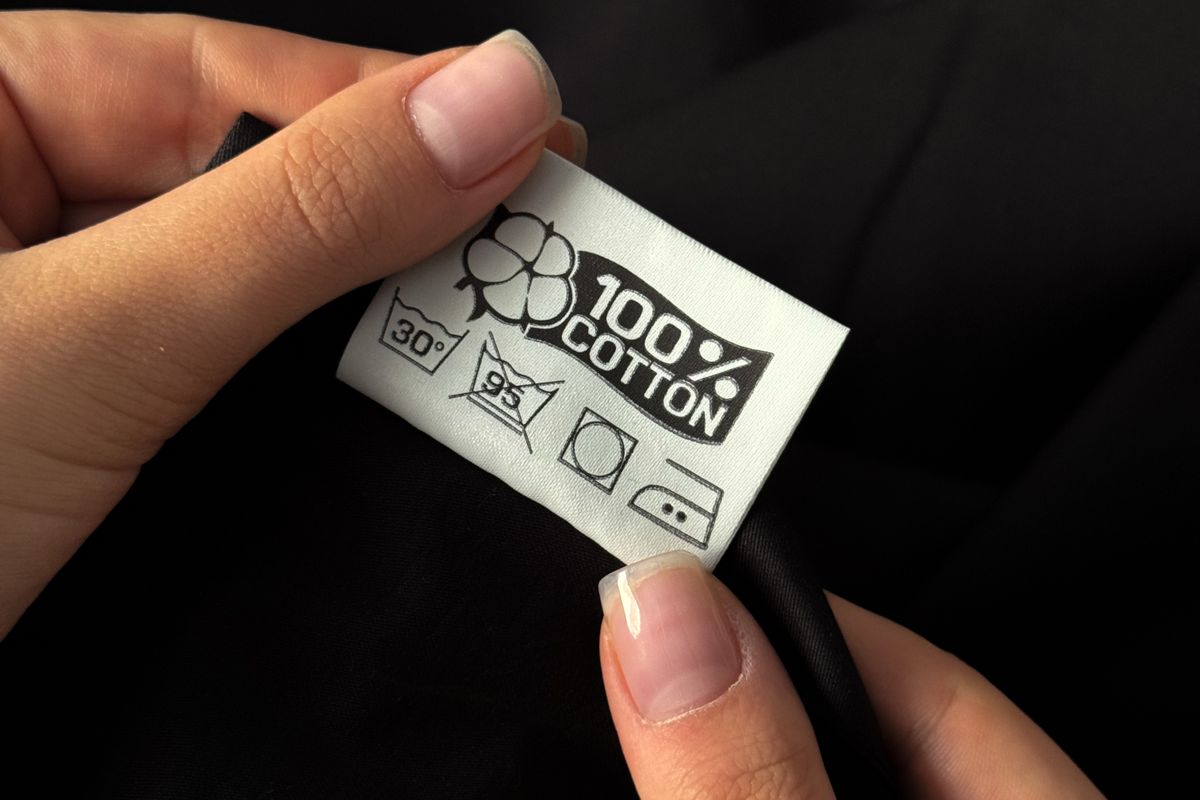
The composition tag is the most honest document in a garment and the most ignored. It tells you what you are buying, how to care for it, and — quietly — whether it can ever be recycled. It is also the one claim on a garment that a regulator will back up, which is why it deserves thirty seconds at the rack. Here is how.
Fibres are listed by majority
The first fibre named is the largest share of the fabric and the rest follow in descending order by weight. That ordering is not house style; it is required. In the US, the Textile Fiber Products Identification Act and its rules at 16 CFR Part 303 require fibre content by generic name in descending order of weight, and the Wool Products Labeling Act adds requirements whenever wool is present. The EU and UK apply Regulation (EU) No 1007/2011, which works the same way.
Two consequences follow. Generic names carry the legal weight, not brand names: a tag may print a trademark next to the generic name, but a branded fibre on its own does not satisfy the requirement — “lyocell” is the name, the brand is not. And small shares get grouped: in the US a fibre below five percent is typically listed as “other fiber” unless it is there to do a job, which is why spandex survives on labels at three percent while an incidental fibre disappears into “other.”
The same garment can also carry different words in different markets. What the US calls rayon, the EU calls viscose; what the US calls nylon, the EU calls polyamide; spandex and elastane are one fibre under two naming systems. A garment made for both markets may legitimately carry two different labels.
What the percentages do not tell you
Stated percentages are tested against a tolerance rather than to the decimal — US enforcement allows a margin of roughly three percentage points between the figure on the tag and what a laboratory finds. Read “60% cotton” as a rounded description, not a measurement.
More usefully: fibre content is not quality. The tag tells you what the fabric is made of, not how it was made. Yarn quality, fabric weight, knit or weave structure, seam construction and finishing are invisible on it, and they decide most of how a garment wears. What the tag does tell you reliably is direction: how the garment will want to be washed, how it will age, and what becomes of it at the end.
What each fibre family signals
Natural cellulosics — cotton, linen, hemp — breathe and biodegrade, wrinkle readily, and in conventional cotton carry a real water and pesticide load. Regenerated cellulosics such as viscose, lyocell and modal start as dissolved wood pulp: plant-based but chemically processed, which is why solvent recovery matters more on this family than any adjective on a hangtag. Protein fibres — wool, cashmere, silk — insulate, resist odour and last for years, want gentler washing, and are the ones keratin-eating moth larvae will find in a drawer. Synthetics — polyester, nylon, acrylic — are strong, cheap and slow to wear out, shed microplastics in the wash, and are hard to recycle back into fibre of comparable quality. A recycled synthetic lowers the virgin input and sheds just the same.
Recycled claims need a standard
A bare “recycled” on a tag is a claim with no auditor behind it. The Recycled Claim Standard verifies that recycled material is present and traces it through the chain of custody; the Global Recycled Standard does that and adds social, environmental and chemical criteria for processing. Both are Textile Exchange standards audited at each step that handles the material. Neither tells you the recycled share unless the tag states it, nor whether the input was post-consumer waste or factory offcuts — for that you need the product page, not the label.
The same logic applies to fibre names. Under FTC enforcement, a textile made from bamboo pulp is rayon, and it has to be labelled rayon or “rayon made from bamboo” unless it is genuinely mechanically processed bamboo fibre; the FTC has brought actions over exactly this. Fibre names on a tag are legal terms, not decoration.
Blends are the recycling problem
A cotton-polyester blend is comfortable and common, and it is also where textile recycling stalls: the two streams have to be separated before either can be reprocessed, and most facilities cannot separate them economically. Mechanical recycling shortens fibres, and chemical routes that handle mixed inputs are limited in practice. A mono-material garment — all wool, all cotton — is dramatically easier to deal with. Even a small elastane share, added for stretch, complicates the process out of proportion to its percentage.
That does not make every blend wrong: a modest synthetic share can add years of wear, and a longer life is often the larger win. The question is what the blend is buying. Durability is a reasonable answer; cost is a weaker one.
Certifications, briefly
GOTS covers organic fibre plus processing, with environmental and social criteria and chain-of-custody audits; the Organic Content Standard covers the content claim only. GRS covers recycled content plus processing criteria; RCS covers the content claim only. The Responsible Wool Standard covers sheep welfare and land management at farm level with chain of custody through the supply chain — it does not by itself cover dyeing and finishing, which is where bluesign or GOTS criteria apply. Bluesign addresses chemical inputs and resource use at the mill. Fair Trade addresses labour at the farm or factory.
None is comprehensive, and a single garment can carry several. A named standard with a certifier behind it is more informative than an adjective; an adjective on its own — eco, conscious, green — is decoration.
The care label is a separate document
The composition tag tells you what a garment is; the care label tells you how to treat it, and in the US it is separately regulated by the FTC’s Care Labeling Rule (16 CFR Part 423), which requires a permanent instruction that actually works — if following it would damage the garment, that is the maker’s problem. Instructions may be written out or given as symbols. Most of the world uses the ISO 3758 system, which sorts washing, bleaching, drying, ironing and professional cleaning into five symbol families; the US also recognises the ASTM standard for care symbols. The number inside the tub is the maximum wash temperature, and the bars under it call for progressively gentler action. Our guide to washing wool sweaters without shrinking them covers how this plays out on the fibre that punishes mistakes fastest.
A thirty-second routine
At the rack: flip the tag, read the first fibre, and count how many follow. One fibre, or one plus a small functional share, means you can predict care and end-of-life from where you are standing. Three or more fibres, or a large synthetic share in a garment sold on naturalness, means asking what the blend is for. Then look for a named certification and read the care label before the price.
Do this for a month and you stop buying surprises. The tag cannot tell you whether a garment is well made, but it can tell you whether the garment is being honest, which is the more useful filter. Our ten essentials that last piece applies the same discipline to what you already own.
FAQ
- What does the order of fibres on a tag mean?
- Fibres are listed by majority, highest first. The first fibre is the largest share of the fabric. A tag reading '70% cotton, 30% polyester' is mostly cotton with a polyester minority that changes care and recycling.
- Are 'recycled' claims on a tag regulated?
- Partly. Certifications like GRS (Global Recycled Standard) are audited; a bare 'recycled' claim without a standard is weaker and worth questioning. Check for a named standard, not just the word.
- Why does a blend matter for recycling?
- Mixed fibres must be separated before they can be reprocessed, and most facilities cannot. A mono-material garment (100% one fibre) is far easier to recycle than a cotton-polyester blend.
Edited by
Dana Reyes
Researches garment construction, fibre content and brand sustainability claims. Ten years between the retail floor and editorial fact-checking.